What is Bourette Silk? Everything about KFO Pure Silk
Silk is silk – you might think. But anyone who has held KFO Pure Silk in their hand and expects it to feel like the smooth filament silk of a satin dress will be surprised. Pure Silk feels different: somewhat matte, with a slight texture that filament silk doesn’t have, and a sheen that is more subtle – but somehow more honest.
This is due to a type of fiber that hardly anyone outside the textile industry knows: Bourette Silk. And behind it is a story more interesting than it sounds.
How is regular silk made?
To understand Bourette Silk, you first need to know how classic filament silk is produced.
The silkworm Bombyx mori produces a cocoon made from a single, continuous protein thread – up to 1,500 meters long. To obtain this thread, the cocoon is dipped in hot water (which dissolves the sericin protein that holds the coils together) and the thread from several cocoons is simultaneously reeled and twisted into a single silk thread.
The result is filament silk: smooth, even, with the characteristic high gloss that has made silk the most expensive natural fiber in the world. The sheen comes from the triangular cross-section of the silk fibroin fiber – it reflects light similarly to a prism.
What happens to the leftovers?
When reeling, leftovers remain:
– Cocoon ends (the beginning and end of each cocoon, which cannot be smoothly reeled)
– Broken threads
– Double cocoons (two silkworms in one cocoon), which cannot be cleanly reeled
– Slip cocoons (from which the insect has already emerged, breaking the thread); this variant is used for Knitting for Olive Pure Silk
These leftovers all contain the same fibroin protein as regular silk – they are not inferior, just shorter and more irregular. They are collected, sorted, cleaned, carded (combed like wool), and spun into a yarn.
The result is Bourette Silk (also called Schappe silk, noil silk, or spun silk). The name comes from the French “bourette” – roughly translated as “flock silk” or “waste silk.” That sounds derogatory but is misleading: Bourette Silk is a distinct product with its own character, not an inferior substitute.
What does Bourette Silk look and feel like?
The difference from filament silk is clear:
Sheen: Bourette Silk shines with a matte finish – not glossy like filament, but with a restrained, natural shimmer. The light is diffusely reflected because the spun fibers lie more irregularly than in the uniform filament structure.
Texture: Carding and spinning create slight slubs and irregularities on the fiber surface – similar to a slightly uneven wool yarn. This gives Bourette Silk texture and character that filament silk lacks.
Touch: Somewhat grippier than filament silk, less slippery. When knitting, Bourette Silk feels more comfortable on the needle – the typical silk slip is moderated.
Drape: Like all silk yarns, Bourette Silk has excellent drape – the finished piece falls fluidly. But due to the slightly more body-giving fiber structure, the drape is less extreme than pure filament silk.
Why is Bourette Silk more sustainable?
Bourette Silk uses material that is waste in the classic silk industry – no new resource input is needed, no additional silkworms. This makes it one of the more resource-efficient silk variants.
Silk in general is controversial from an animal welfare perspective – the larvae die when the cocoon is reeled. Bourette Silk does not change this fundamental issue but makes fuller use of existing resources. For those who consciously work with natural materials, this is a relevant consideration.
KFO Pure Silk: Bourette Silk in its pure form
Knitting for Olive Pure Silk is a fingering yarn made from 100% Bourette Silk – no blends, no wool content, pure. This makes it unusual in the knitting world: most silk yarns are blends. Pure Silk is the opposite: concentrated, direct, unblended.
The yarn comes in the typical KFO aesthetic: restrained colors, no surprises. Due to the matte Bourette character, the colors appear somewhat deeper and more natural than industrial high-gloss yarns. A camel tone in Pure Silk looks different than in Merino – warmer, earthier, richer.
Meterage and Needle Size: Since pure silk yarn has no natural elasticity, a slightly tighter gauge than with wool is recommended. Pieces with good structure are created on 2.5–3mm needles.
What can you knit with KFO Pure Silk?
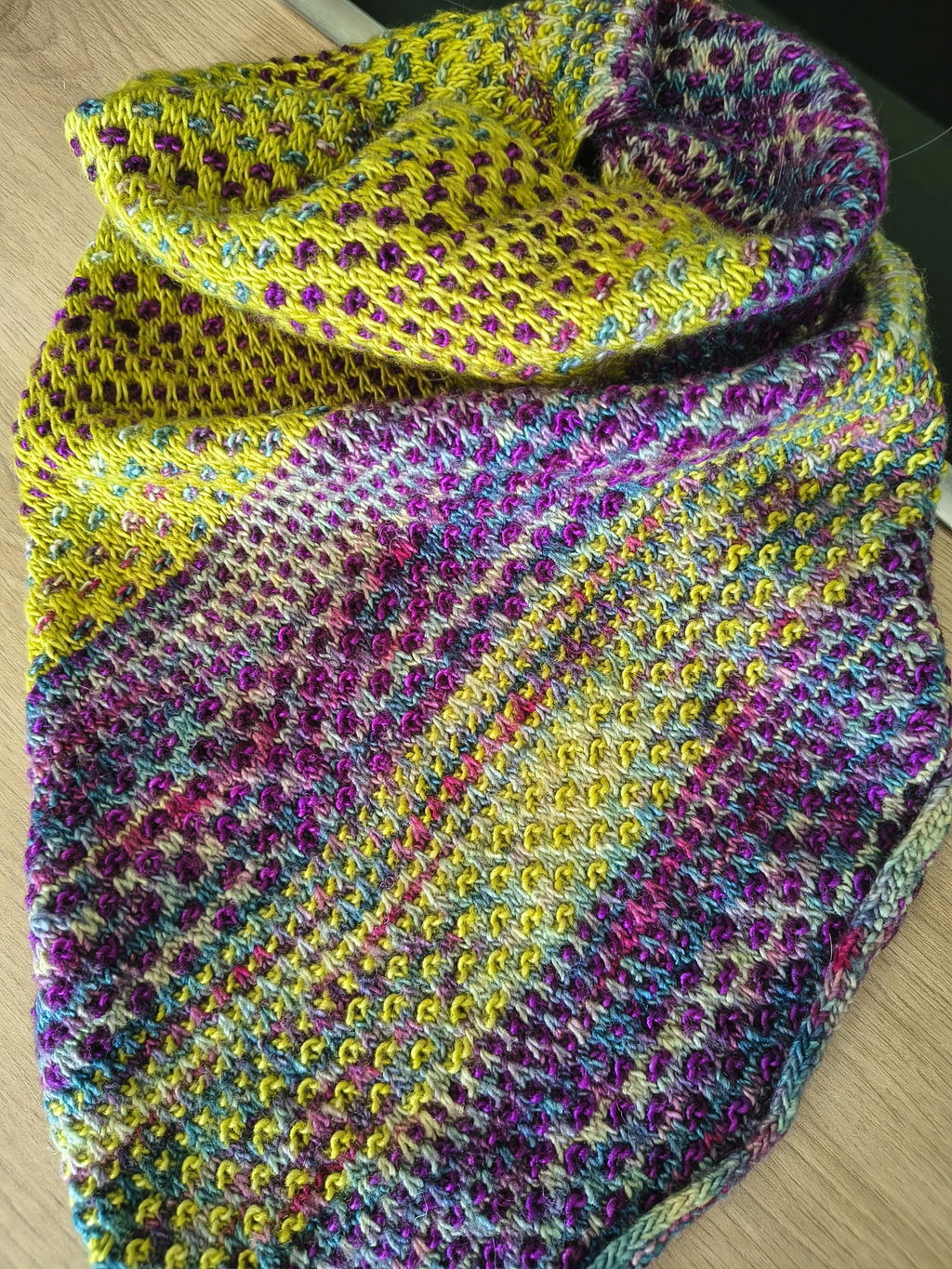
Shawls and stoles: The main application area. A shawl made from Pure Silk falls differently than a wool shawl – softer, more flowing, with more movement. It absorbs body warmth and feels pleasant. For festive occasions, summer events, or as a simple everyday piece for those who love silk.
Scarves for warm days: Silk is naturally cooling – it absorbs body heat and releases it slowly. A lightweight silk scarf is more comfortable in summer than wool.
Accessories and details: Edgings, collars, cuffs on wool sweaters. The sheen difference between wool and Pure Silk creates targeted accents.
Combination projects: Pure Silk as a companion to Merino or Alpaca – the silk gives the blend drape and sheen, the wool provides warmth and structure.
Not suitable: Socks (no elasticity, no nylon content), heavy structured sweaters with a lot of weight (silk pieces can stretch).
Care for KFO Pure Silk
Silk is delicate. The most important points:
Temperature: Hand Wash at a maximum of 30°C, lukewarm. Hot water irreversibly destroys the protein structure of silk.
Detergent: Only mild Wool Wash or shampoo. No regular detergent, no enzyme cleaners.
Drying: Flat on a towel. Never in the sun – UV radiation causes silk to fade and lose strength over time. Never in the dryer.
Ironing: If at all, on the lowest setting (silk program), never directly on the fabric.
Bourette Silk vs. Filament Silk vs. Silk Blends: An overview
Filament silk: High gloss, smooth, expensive, less common in knitting yarns. More common in woven textiles.
Bourette Silk (KFO Pure Silk): Matte-shimmering, textured, more resource-efficient, with its own character. The more honest of the two.
Silk as a blend (e.g. Manos del Uruguay Fino, 30% silk | Fyberspates Cumulus, 20% silk): The most common variant in knitting. Silk as a complement to Merino or Alpaca – brings sheen and drape, wool brings warmth and structure. The most practical option for most projects.
All three have their justification. If you want to understand silk, start with Bourette Silk – it shows what the fiber can really do without other fibers clouding the impression.