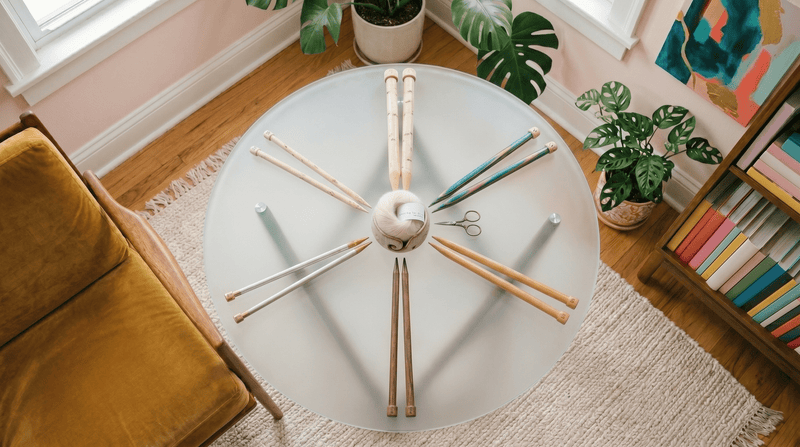
Knitting Needles are the most important tool for knitting. And yet most beginners think little about them – they take whatever is available or buy the cheapest set at the drugstore. This usually changes with the first quality needle set: suddenly knitting is more fun, goes faster, and the results are more even.
This article explains all relevant needle types, what materials are available, how to choose the right Needle Size, and what is really worth investing in.
The four main needle types
There are four basic types of knitting needles. Each has its justification – the choice depends on the project and personal preference.
1. Straight Needles
The classic knitting needles that most people know: two straight needles, rounded at one end or with a stopper. Always knit back and forth – so flat.
Single needles are used much less today than in the past. The main reason: Circular Needles have replaced them in many areas because they are ergonomically superior. With Circular Needles, the weight of the project rests in the lap instead of on the wrists – with a large scarf or blanket, this makes a huge difference for hands and shoulders. Also, many modern projects are knitted seamlessly (in the round), for which single needles are not suitable. However, for flat knitting of scarves, rectangular blankets, or separately knitted parts of a Sweater, they are still practical.
Advantage: Simple, familiar, no cable in the way. Disadvantage: Not suitable for knitting in the round. For large projects, the needles quickly become unwieldy and strain the wrists.
2. Double Pointed Needles (DPN)
Short needles with a point at both ends. Used in sets of 4 or 5 needles and allow knitting in the round for small circumferences – where a Circular Needle would be too long.
The classic use: Socks, sleeves (when they become very tight at the toe), hats when decreasing towards the top, small tubes, and collars.
DPN have a reputation for being complicated – especially at the beginning, when the knitting piece with several loose needles seems unwieldy. After the first centimeter of knitting, everything fits, and many knitters love DPN for their compactness: the set fits in any bag.
Material recommendation: Wood (Bamboo) for beginners. The needles are lighter and the yarn slips off less quickly than with metal needles.
3. Circular Needles
A Circular Needle consists of two short needle tips connected by a flexible cable. The stitches slide on the cable; the actual work happens at the tips.
Circular Needles can be used for both circular knitting and flat knitting. This makes them the most versatile needle type: A set of Circular Needles can completely replace single-pointed needles.
For circular knitting: The cable length must be shorter than the circumference of the knitted piece. For a Sweater (body circumference approx. 80–100cm), use an 80cm needle. For a sleeve or a Hat, use a 40–60cm needle. For very small circumferences (Socks, sleeve toes), switch to DPN or Magic Loop.
Magic Loop: A special case is the Magic Loop method. With a very long Circular Needle (80–100cm), you can knit very small circumferences – the stitches are divided into two halves and the excess cable forms a loop. This completely replaces DPN if you prefer the method.
Advantage: Versatile, usable for all project sizes, no losing needles. Disadvantage: Quality cables make a big difference – cheap cables can twist and make knitting frustrating.
4. Interchangeable Needles (Changeable Needle Sets)
The most flexible system: Several needle tips (different Needle Sizes) plus cables (different lengths) that can be freely combined. You buy one set and have all Needle Sizes and lengths in one.
Interchangeable Needles are the most economical solution in the long run for regular knitters. Good sets (like Knit Pro Symfonie, Addi Clicks, or ChiaoGoo Red Lace) cost more than individual needles – but pay off over many projects.
What to keep in mind: Not all Interchangeable systems are compatible with each other. Needle tips and cables from different brands often do not fit together.
Needle materials: Wood, Metal, Plastic
The material of the needles significantly influences the knitting experience. The three most common materials:
Wood and Bamboo
Lightweight, warm in the hand, with a natural grip that holds the yarn easily on the needle – not too slippery. This is especially advantageous for beginners (stitches don’t just slip off the needle) and for smooth, slippery yarns like Silk or Cotton.
Bamboo is somewhat more flexible and cheaper than wood. Wooden needles (cherry, walnut, oak) are a bit sturdier and have a more pleasant weight in the hand.
Disadvantage: Less durable than metal. Cheap wooden needles can splinter or break. Recommendation: ChiaoGoo Bamboo, Knit Pro Symfonie (Wood Interchangeable)
Metal (Stainless Steel, Brass, Aluminum)
Smooth, fast, very durable. Yarn slides very quickly on metal needles – which brings speed for experienced knitters, but for beginners sometimes causes stitches to slip off.
Metal needles are the most durable. They don’t break, don’t get rough, and keep their shape permanently. For wool that needs some grip on the needle (like Mohair), metal needles are sometimes less ideal – the Mohair halo can catch on needles that are too smooth.
Recommendation: Addi (Brass/Stainless Steel), ChiaoGoo Red Lace (Stainless Steel), Knit Pro Nova (Brass)
Plastic and Acrylic
Affordable, lightweight, and well suited for many beginner projects. The difference to wood and metal needles is noticeable in expensive projects, but absolutely sufficient for first practice projects.
For thick yarns (Aran, Chunky) and very large needle sizes (7mm+), plastic needles are often the lightest option – heavy metal needles at 10mm needle size can strain the wrist.
For those who want to dive deeper into the differences between wood, metal, and Carbon: Our detailed Needle Materials Comparison covers the topic in detail.
Needle Size: How to choose it?
The needle size is always indicated on the yarn ball label – as a recommendation from the manufacturer. This recommendation is a starting point, not a fixed rule.
The actual Needle Size for a specific project depends on the Gauge: How many stitches form over 10cm with this yarn on this needle? If the gauge is too tight (more stitches than specified), use a larger needle. Too loose: smaller needle.
As a guide for common yarn weights:
- Lace (KFO Soft Silk Mohair): 2.5–4mm
- Fingering (KFO Merino, Sock Yarns): 2–3.5mm
- Sport Weight: 3–3.75mm
- DK (KFO Heavy Merino): 3.5–4.5mm
- Worsted (Malabrigo Rios): 4.5–5.5mm
- Aran: 5–6mm
- Chunky: 6–10mm
The cable quality of Circular Needles: What many underestimate
For Circular Needles, the cable makes the biggest difference. Poor cables (most cheap sets) have plastic cables that twist over time, develop kinks, and interrupt knitting by requiring constant smoothing.
Good cables (ChiaoGoo Red Lace, Knit Pro Nova Metal, Addi Clicks) are made of steel or high-quality plastic – they lie flat, have no memory for kinks, and roll up easily. If you make only one investment in knitting equipment, make it here.
What Do Beginners Need?
A few needles are enough to start:
An 80cm Circular Needle in the Needle Size for your first project (usually 4–4.5mm for DK). This one needle can be used for sweaters, hats, and shawls.
A set of DPN in 2.5mm for Socks (if you want to knit socks). Or an 80–100cm Circular Needle in 2.5mm for Magic Loop.
Optional: a second Circular Needle in 2.5–3mm for Fingering shawls.
That’s all you need at the start. A complete Interchangeable Set comes later, once you know which Needle Sizes you use regularly.
Recommended Starter Investment: A high-quality Circular Needle from ChiaoGoo or Knit Pro in the right size. It costs more than a drugstore needle – but the difference in knitting is immediately noticeable.
Needle Care and Storage
Occasionally polish wooden needles with a linen cloth – this keeps the surface smooth. Do not store bamboo needles in the sun (it can make them brittle).
Metal Needles: Practically maintenance-free. Just keep them clean.
Interchangeable Sets: Regularly check and tighten the screw connections between needle tips and cables – preferably with the small tightening key included with most sets. Connections tightened only by hand almost always loosen during knitting, causing you to lose stitches. A quick check with the key before each project reliably prevents this frustrating problem.
Storage: A needle roll (Roll-Up Needle Case) is ideal for DPN and single needles. Interchangeable sets often have their own pouch. Needles should be stored dry and without pressure on the tips.
Read More:
